
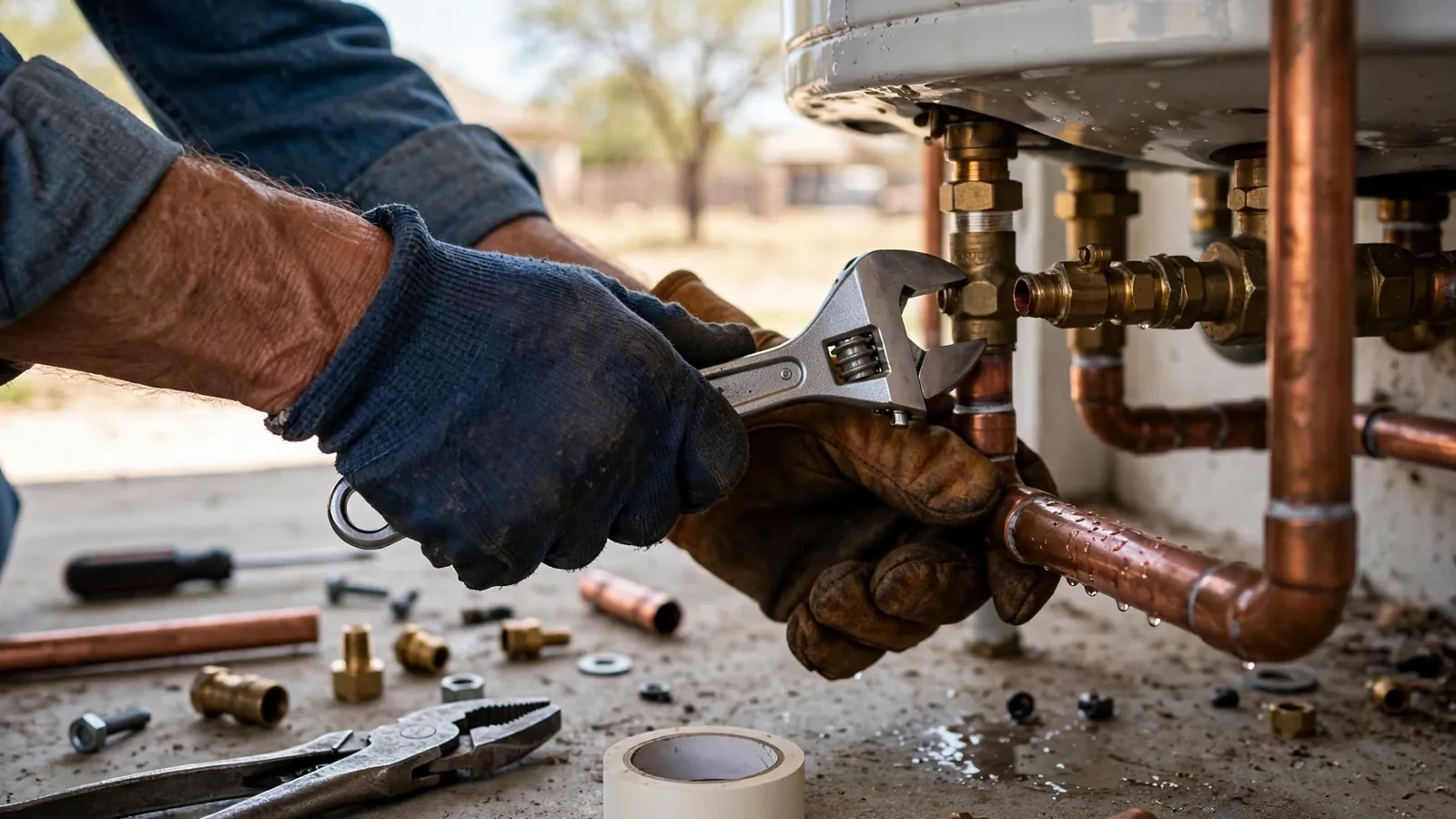
When a water heater problem is an emergency
A heater that merely runs lukewarm can wait for a scheduled visit. Water pooling around the base, a rotten-egg smell, a pilot that keeps going out, or a relief valve discharging steadily should not wait.
A tank leak is the one that costs the most if you ignore it, since the water keeps coming until the supply is closed. Closing that cold valve is the single best step before we arrive.
Before we arrive
- Turn the cold water supply valve on top of the heater to closed.
- Switch an electric heater off at its breaker, or set a gas heater control to off.
- Move stored items away from the base and place a pan or towels where the water is traveling.
- If you smell gas, leave the house and call 911 from outside. Do not light anything or flip switches.
Gas or electric: what usually fails
| Symptom | Gas heater, likely cause | Electric heater, likely cause |
|---|---|---|
| No hot water at all | Pilot out, thermocouple or gas valve | Tripped breaker, high-limit switch or both elements |
| Water is warm, not hot | Dirty burner or failing thermostat | One burned-out element or a thermostat fault |
| Popping or rumbling noise | Sediment layer on the tank floor | Sediment burying the lower element |
| Water at the base of the tank | Relief valve, fitting or tank failure | Relief valve, fitting or tank failure |
| Rusty or smelly hot water | Worn anode rod in the tank | Worn anode rod in the tank |
Repair or replace: the honest test
The U.S. Department of Energy's building guidance puts the life of a tank-type heater at roughly 10 to 15 years. A heater inside that range with a bad element or thermostat is a good repair candidate. A heater past it with a weeping seam is not, because the steel is the part that is failing and no part fixes that.
We tell you which side your heater is on. If the answer is replacement, our water heater replacement page explains what that visit involves, and a gas-to-tankless switch is covered under tankless water heater service.
What Issaquah water does to a tank
The City of Issaquah's 2021 water quality report, which reflects 2016 sampling, lists hardness in its Lower Issaquah Valley Aquifer wells at 52.6 to 100.2 mg/L as calcium carbonate, with an average of 74. By the standard conversion that is roughly 3 to 6 grains per gallon, on the soft side of moderate. The same report says the city also buys regional water from the Cascade Water Alliance, and hardness for that supply is not listed.
What this means for your heater: scale builds more slowly here than in very hard water areas, but sediment still collects, and a yearly flush is cheap insurance. Test your tap or ask your water utility for the current report, since your street may be on well water, regional water or a mix.
Homes in South Lake Sammamish, Lakemont and Montreux are normally on regional supply, while Issaquah Highlands and Talus normally are as well. That affects water temperature and mineral content, not whether your heater can be repaired.
Heater down or leaking? Call and we will dispatch a technician.
Call (425) 845-0257What changes the cost of a water heater repair
A thermostat, element, igniter or thermocouple differs in price, and gas and electric units use different parts.
A newer unit with a good tank justifies a repair. An old unit with a leaking tank does not.
Attic, crawl space or closet installs take longer than a garage floor setup, and a gas flue may need attention.
A missing expansion tank, relief discharge line or seismic strap may need to be added, since the work is already open.
Night and weekend visits carry their own rate, quoted before we start.
Warranty coverage on the heater itself depends on the manufacturer and install date, so keep the model label handy. Want your real number? Call (425) 845-0257.
Other work that often comes with a heater visit
Heater repairs often uncover related issues. A pinhole leak on the supply line is a job for leak detection, and corroded fittings near the tank may call for plumbing installation work on valves and connectors. If you are planning a larger update, water heater installation covers new placements and upgrades.
Yes. A leaking or dead water heater can happen at any hour, and dispatch answers 24/7. Call, tell us whether the heater is gas or electric and whether water is on the floor, and we give you an arrival window before sending anyone. Shut the cold supply valve above the tank and switch off its power or gas control in the meantime.
A leak from the bottom is often the tank itself, which means replacement. Sometimes it is only a drain valve or relief valve discharging, and those are repairable. We check the fittings and the tank seams before telling you which one it is.
Not for long. Shut the cold supply and the power or gas control, and call. A small weep can become a flood without warning, and an electric element running in a tank that is losing water can burn out.
Many repairs, like a thermostat, element or igniter, finish in one visit if the part is on the truck. Special parts or a failed gas valve can mean a second visit, and we say so up front.
Permit rules vary by the work involved, so ask the City of Issaquah permit center about your specific job. We tell you what we see on site and what the work involves.
Draining a few gallons from the tank carries out sediment that otherwise insulates the burner or buries the lower element. That cuts noise and helps the heater run efficiently as it ages.
Want a technician to look at your heater? Call and ask for the next slot.
Call (425) 845-0257Standards and sources for water heater repair
Gas water heater work follows the Uniform Plumbing Code as adopted in Washington under WAC 51-56. If you smell gas, leave the building and call Puget Sound Energy, as the utility's own gas safety page instructs.