
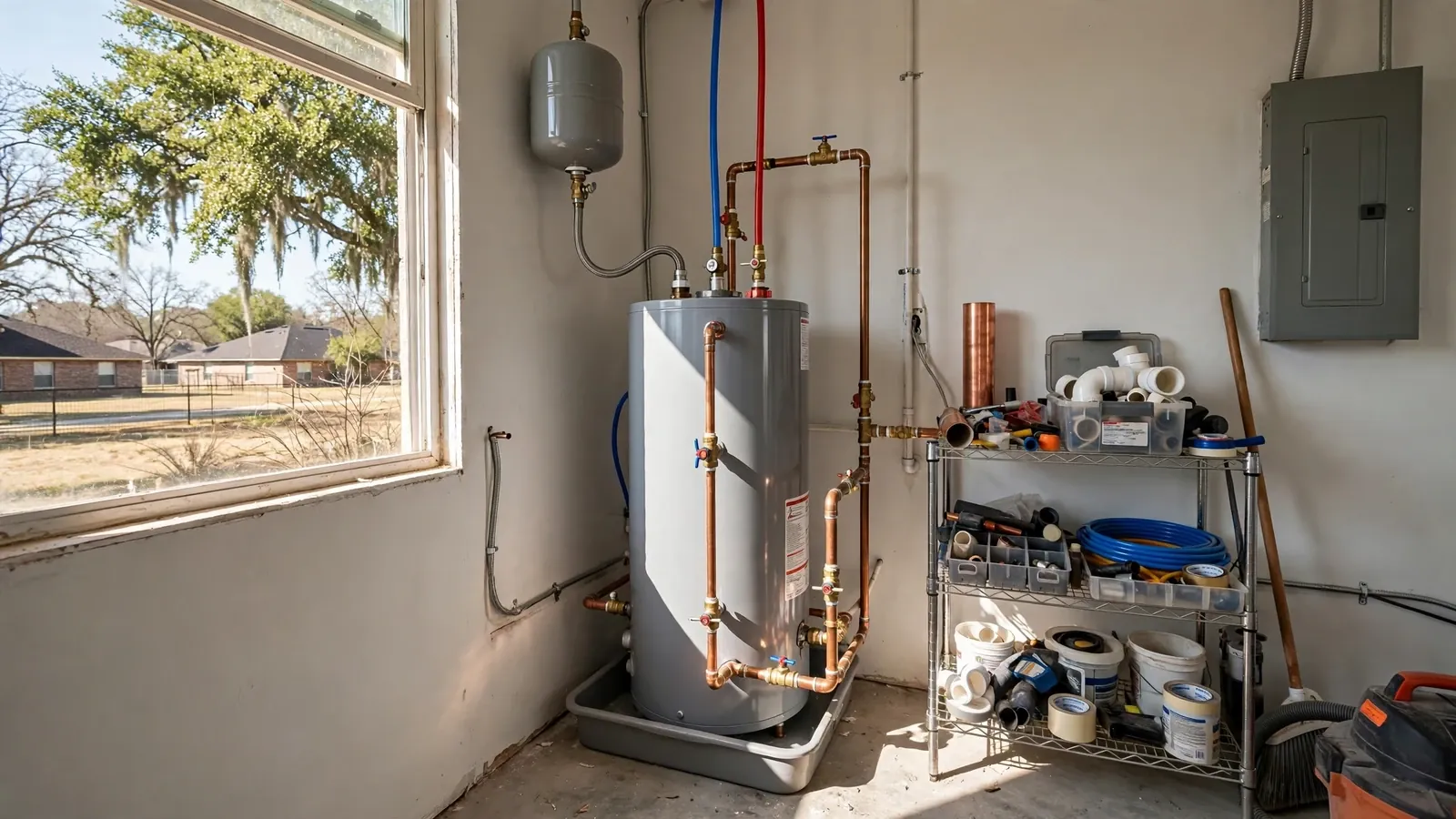
Where installation differs from a replacement swap
A replacement reuses what is already there. An installation often means new gas or electric hookups, a new venting path, a new floor drain or a new spot entirely. Those details decide the cost and the permit questions more than the tank does.
If your heater just failed and you need hot water now, that is a replacement job and follows a faster path.
Planning checklist before the install
- Decide gas or electric, and confirm your panel or gas line can support the choice.
- Pick a location with room for service access, a relief discharge and drainage if the tank ever leaks.
- Confirm venting clearance if the heater burns gas.
- Ask whether a pressure reducing valve and expansion tank belong in the system.
- Check permit rules with the City of Issaquah permit center for your specific work.
Fuel and tank choices compared
| Fuel or type | Strength | Install detail to plan for |
|---|---|---|
| Natural gas tank | Fast recovery for large households | Gas line size, flue and combustion air |
| Electric tank | Simple venting, flexible location | Dedicated circuit and breaker capacity |
| Heat pump tank | Efficient electric operation | Clearance, condensate drain and cool-room effect |
| Tankless unit | Compact and continuous hot water | Larger gas line or electric load. See tankless service |
What a clean install includes
We set the heater on a stable base, fit isolation valves so future service is simple, and connect the supply with flexible connectors or hard pipe as the space allows. A temperature and pressure relief valve gets a full-size discharge line routed to a safe location.
If your home has a pressure reducing valve, we check its setting, because an expansion tank needs it to work properly in a closed system. Then we walk you through the shutoffs and thermostat.
On new work we also strap the tank for earthquake safety. Western Washington is earthquake country, and a strapped heater is less likely to shift and strain a gas or water line in a shaking event.
Planning an install? Call and we will discuss options and scheduling.
Call (425) 845-0257What changes the cost of a water heater installation
A heat pump or high-capacity tank costs more than a standard 40 or 50 gallon unit.
New gas lines, electric circuits or venting paths add real labor and may require permits.
Attics, closets and tight utility rooms increase install time.
Expansion tanks, pressure reducing valves, straps and discharge lines are part of a proper install.
Old tank removal and disposal are included in the quote.
Some utility or manufacturer rebates exist for efficient models, so ask the utility serving your address. Want your real number? Call (425) 845-0257 and we quote before starting.
Related work at the same visit
While the plumber is on site, it often makes sense to look at nearby supply lines or shutoffs. Plumbing installation covers the general fixture and pipe side, and water heater repair helps if you are not ready to replace the old unit. The Sammamish Plateau side is reached through our Sammamish dispatch area.
Yes, though it changes the scope. A move means new supply and drain routing, possibly new venting or circuits, and can require a permit. We map it out before quoting.
In many closed-loop systems, yes. A pressure reducing valve or backflow device can trap expanding hot water, and an expansion tank absorbs it. We check your setup and tell you.
Compare your first-hour need to the tank's first-hour rating. We ask about fixtures and household size to size it correctly.
Permit rules vary by work type, so ask the City of Issaquah permit center about your project. We tell you what the install involves so you can ask accurately.
Yes. We install both, along with heat pump tanks and tankless units. Gas work follows safety rules about venting and shutoff placement.
Want a plan for your install? Call to set it up.
Call (425) 845-0257What to do before we arrive
- Shut off the cold supply valve above the old heater if it is leaking.
- Turn the gas control to off, or switch off the breaker for an electric unit.
- If you smell gas, leave the building and call Puget Sound Energy from outside.
- Clear a path to the heater so the plumber can reach it.
Standards and sources for water heater installation
New installations follow the Uniform Plumbing Code as adopted in Washington under WAC 51-56. MyBuildingPermit.com covers Issaquah and explains which water heater work needs a permit.