
Signs you have a hidden leak
Not every leak shows up as a puddle. A water bill that jumped without a change in habits, a musty smell, warm spots on a floor, the sound of water running when nothing is on, or paint that bubbles all point to water moving where it should not.
EPA WaterSense estimates that the average household's leaks waste more than 9,300 gallons a year, and nine percent of homes have leaks that waste 50 gallons or more per day.
Two checks you can do before we arrive
Read your water meter, wait two hours without using any water, and read it again. EPA guidance says that if the meter changes, you probably have a leak. For toilets, add a few drops of food coloring to the tank, wait ten minutes without flushing, and see whether color shows up in the bowl. EPA says that means a leak, and a flush afterward keeps the stain off the tank.
When a leak turns into an emergency
A leak is an emergency when water is coming through a ceiling, running down a wall near electrical outlets, collecting under a floor, or flowing from a line you cannot shut off. In those cases close the main valve, switch off power to the affected area if it is safe to reach the panel, and call.
We answer after hours and on weekends. Same-day visits are normal for active leaks, and the arrival window is told on the call.
How we find a leak without opening the wall
| Method | What it does | Best for |
|---|---|---|
| Pressure test | Isolates a line and watches for a pressure drop | Confirming a leak exists in a supply line |
| Acoustic listening | Hears the hiss of escaping water through a surface | Slab and underground supply leaks |
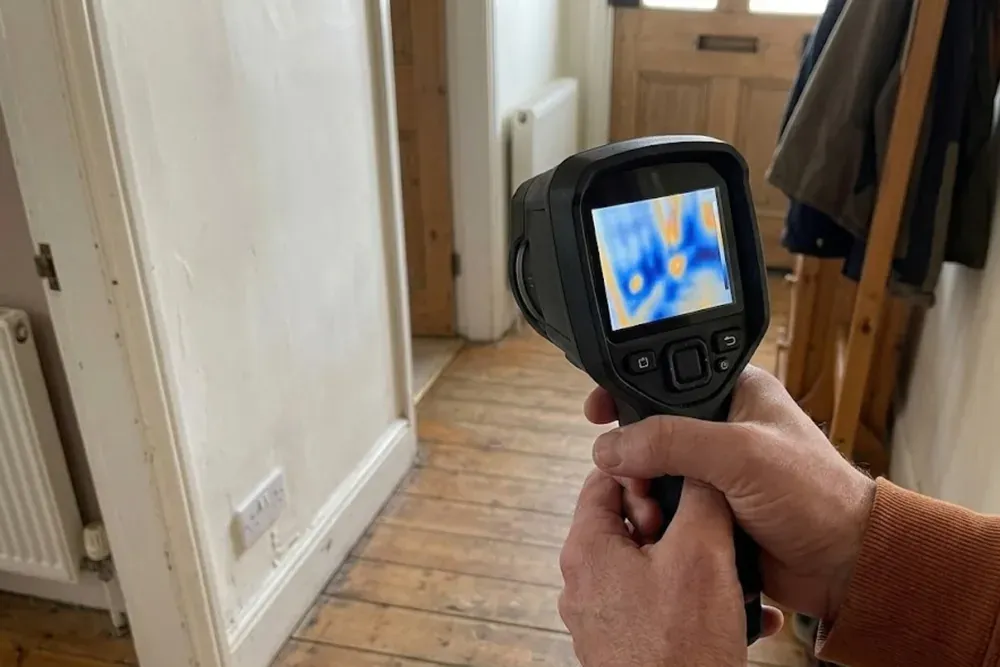
| Thermal imaging | Shows temperature differences from moisture or hot water | Ceiling, wall and hot-line slab leaks |
| Moisture meter | Maps how far dampness has spread | Setting repair boundaries after a leak |
| Line locator | Traces buried pipe paths | Yard and service line leaks |
The method depends on the symptom. A hot-water slab leak often shows up as a warm tile with a thermal camera. A cold line under a yard may need listening gear and a locator. The aim is always the same: mark the spot, explain the repair and keep the hole small.
Slab leaks, meter spin and ceiling stains: what each means
A leak under a concrete slab shows up as warm floors, wet carpet edges, or water at the slab edge in a garage. The fix may be a spot repair or a reroute, and we explain both.
A meter that spins with everything off points to a leak between the meter and the house, or inside it. A ceiling stain points upward, to a supply line, a drain or a roof leak, and we find which before anyone cuts drywall.
Suspect a hidden leak? Call and we will tell you how to narrow it down.
Call (425) 845-0257Local water facts that help in a leak search
The City of Issaquah's utility handles water service and lists 425-837-3470 as its contact in the 2021 water quality report. If your bill jumped, ask the utility about the meter reading history. That helps us decide whether the leak is likely inside the house or on the service line.
Wet winters and the creek corridor keep soil damp across much of Issaquah, and damp soil can mask a small yard leak. A locator and listening gear separate natural dampness from a pipe that is losing water.
What changes the cost of leak detection
A single bathroom wall is a smaller search than an entire slab or a long yard line.
Thermal imaging, acoustic listening and pressure testing take different time and equipment.
Closed-off areas slow the search.
Detection tells you the location. Repair is separate, and cost depends on the pipe type and depth.
Larger systems take longer to isolate.
Homeowner policies often cover sudden pipe leaks but not the repair of a gradual leak, so check your policy and keep photos. Want your real number? Call (425) 845-0257.
Related help once the leak is found
A pinpointed leak in a supply line may be handled as water line repair, and a burst or split pipe follows the steps in burst pipe repair. If the water heater is the source, see water heater repair. Nearby Sammamish homes reach us through the Sammamish page.
Yes. Active leaks do not wait for business hours, so dispatch answers 24/7. Call, tell us where you see water and whether the main shutoff is closed, and we give you an arrival window. If water is spreading, close the main valve and switch off power to the wet area if you can reach the panel safely.
Often yes. Thermal imaging, a moisture meter and listening gear usually narrow the location to a small area so the opening is as small as it can be.
Close your main shutoff and watch the meter. If it still moves, the leak is between the meter and your shutoff. Ask your water utility where its responsibility ends and yours begins.
If every fixture is off and the meter still moves, water is escaping somewhere. A toilet running silently is a common source, and we check that first before searching for hidden lines.
Active water coming up through a floor is. Otherwise it is urgent but schedulable. Shut the main if water is spreading, and call so we can plan the detection.
Yes. Commercial properties have longer lines and more fixtures, and we coordinate around operating hours. See commercial plumbing for scope.
Want the leak found before it gets worse? Call and ask for detection.
Call (425) 845-0257Standards and sources for leak detection
The EPA WaterSense program estimates household leaks waste about 9,300 gallons a year, and says a drip a second adds up to more than 3,000 gallons. Its water meter test, watching the meter over two hours with everything off, is the check we describe above.