
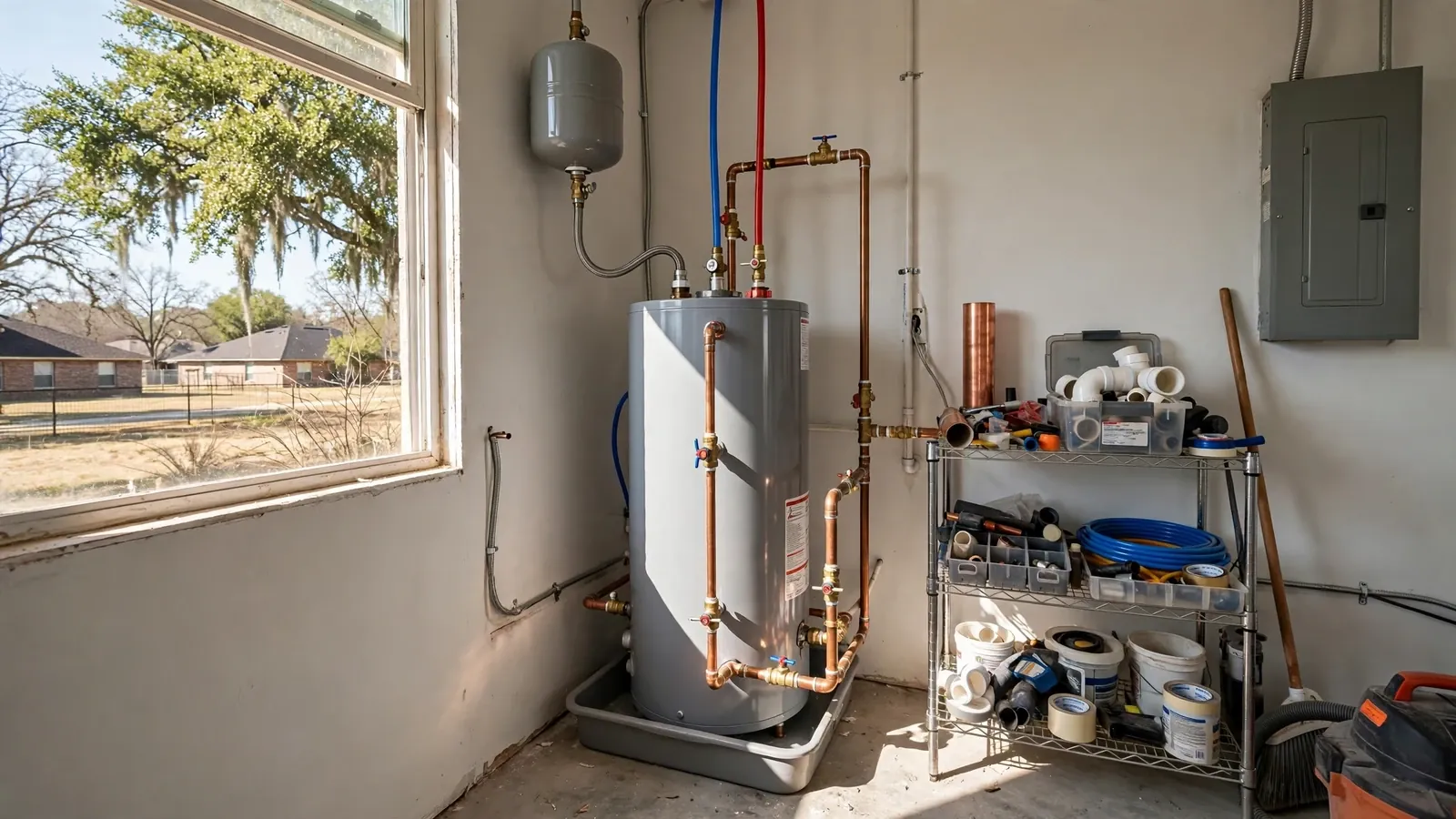
Four installation scenarios
| Scenario | Extra work involved | Cost impact |
|---|---|---|
| New construction or addition | Rough-in of supply, drain and venting | Depends on layout |
| Moving the heater | New supply and drain routes, possibly venting | Moderate to large |
| Gas to electric or the reverse | New circuit or gas line, venting changes | Moderate to large |
| Tank to tankless | Larger gas line or electric load, new venting | Often the largest |
A like-for-like swap is the least expensive. See our water heater replacement page for that path.
The parts that go with a good install
- Isolation valves for easy service.
- A temperature and pressure relief valve with a full-size discharge line.
- An expansion tank where the system is closed.
- Seismic straps.
- A drain pan or a floor drain in finished areas.
These parts protect the tank and the house. A bid without them may look cheaper, but it leaves risks in place.
Where the heater goes
Garages, utility rooms, closets and basements are common. Each has trade-offs. A garage is easy but exposes the heater to cold. A closet is tidy but needs clearance and venting. A basement near the creek may need a drain or pan in case of leaks.
Choose a location that allows service access. A heater boxed in behind a wall is expensive to replace later.
A planning checklist before you get quotes
- Photograph the current heater, the label and the space around it.
- Note the fuel, the tank size and the age of the unit.
- Decide whether you will move it, convert fuel or keep the same setup.
- Check the electrical panel for spare capacity if electric is an option.
- Ask each bidder to list venting, code parts and haul-away in writing.
Bringing this information to the first call lets the plumber give a more accurate range and tells you what site visit questions to expect.
Efficiency choices that change the price
Higher efficiency models, such as heat pump tanks or condensing gas units, cost more up front and may lower running costs. Whether that pays back depends on how much hot water you use and on local utility rates and any rebates available to you.
Ask the utility serving your address about current programs before you buy, since rebates change and depend on the model.
Where installs run into surprises
The most common surprises are an old flue that no longer meets current practice, a gas line that is too small, a panel without room for a new breaker and shutoff valves that will not turn. None of them is rare, and each adds work.
A site visit before the quote is the best protection. A plumber who sees the space can list the likely add-ons, and you can compare bids with those items included.
Code and safety parts worth paying for
Some parts do not make a heater run better, but they keep a failure from becoming a disaster. A relief valve with a proper discharge line, a drain pan where leaks could damage finished space and seismic straps are common examples. A quote that includes them is a more complete quote.
If a bid is much lower than the rest, check what it leaves out. Often the missing piece is one of these safety parts, which you would end up paying for anyway.
Ask whether the installer registers the warranty for you. Some manufacturers require registration within a set window, and a missed deadline can shorten coverage. A plumber who handles the paperwork saves you a task and protects the warranty.
Issaquah supply and permit notes
The City of Issaquah's 2021 water quality report says Issaquah Highlands and Talus normally receive Cascade Water Alliance water but can receive groundwater in unusual circumstances, such as planned or unplanned infrastructure work. South Lake Sammamish, Lakemont and Montreux residents receive regional water. Well hardness is reported at about 3 to 6 grains per gallon by standard conversion.
What this means for an install: your incoming water may change source, so plan a yearly flush and ask the utility about your street. For permits, rules depend on the work, so ask the City of Issaquah permit center.
Source type: City of Issaquah 2021 water quality report
Timeline
A standard install takes a few hours. A move, conversion or tankless install may need a second visit for gas, electrical or venting work. Plan for a day or two without hot water if you are changing fuel.
Ask the plumber to tell you before the visit what will be done on day one. Our water heater installation page explains each part of the process.
If you are installing a heater in a Sammamish home, start from our Sammamish page and ask about your water district. The service area page lists the places we work.
Planning an install? Call (425) 845-0257.
Call (425) 845-0257The layouts differ, so the venting and clearance questions differ. Newer master-planned housing often has compact spaces, and older mid-century homes can have older valves and flues.
Only if the new location is better for service and venting. Moving adds plumbing and may add permit steps.
A like-for-like swap in the same spot. Changes to fuel, location or type add work.
In many closed systems, yes. We check your setup and tell you.
Match heater type, fuel, venting scope, code parts and haul-away on both.